• See all

    No search result found

    It looks like we couldn't find any results for your search.

    Helpful links

    Strategic Funding Advice
    Project Management Advisory
    EU
    Norwegian
    Spanish
    Proposal Development
    Corporate Finance
    Danish
    Swedish
    Contact us
  • What we do
    • Strategic Finance Advisory
      • Strategic Funding Advice
      • Proposal Development
      • Project Management Advisory
      • Green & Clean Tech funding
    • Corporate Finance
      • Growth Financing and M&A
      • Valuation Services
    • Sustainability Advisory
      • Preliminary Assessment
      • ESG Strategy & Compliance
      • Certification support
  • Funding Programmes
    • EU Greentech Programmes
      • EU Innovation Fund
      • Hydrogen Auction
      • Heat Auction
      • Clean Industrial Deal
      • LIFE
      • Horizon Europe Collaborative Projects Green
      • Connecting Europe Facility (CEF)
      • Clean Hydrogen Partnership
      • Circular Bio-based Europe
      • Clean Energy Transition (CET) Partnership
    • Other EU Programmes
      • Eureka Eurostars
      • EIC Accelerator
      • Horizon Europe Pillar II
      • European Defence Fund (EDF)
      • EIC STEP Scale Up
      • EIC Pathfinder
      • EIC Transition
      • European Research Council
      • Marie Skłodowska-Curie Actions
      • EIC Advanced Innovation Challenges
      • EIC Pre-Accelerator
      • NATO DIANA
      • European Chips Act
      • Eureka Xecs
      • EUROGIA 2030
    • Danish Programmes
      • Innobooster
      • Grand Solutions
      • GUDP
      • MUDP
      • EUDP
      • EUopStart
      • Innofounder
    • Norwegian Programmes
      • SkatteFUNN
      • The Research Council of Norway
      • Innovation Norway
      • ENOVA
    • German
      • Forschungszulage
      • Zentrales Innovationsprogramm Mittelstand
    • Spanish programmes
      • CDTI NEOTEC
    • Swedish Programmes
      • Swedish Energy Agency
      • Vinnova
  • Industries
    • Green Transition & Clean Tech
      • Hydrogen
      • Renewable Energy
      • Batteries and other energy storage systems (ESS)
      • Carbon capture, use and storage (CCUS) technologies
      • E-fuels and biofuels
      • Sustainable and circular products and materials
      • Transport and Mobility
      • Others within Green Transition
    • Health and Life Science
      • Pharmaceuticals
      • MedTech including diagnostics
      • e-Health
    • Other Industries
      • Defence Funding
      • Quantum Technologies
      • Artificial Intelligence
      • Natural Resources and Environment
  • Case Overview
  • Who we are
  • Blog
  • Contact us
  • Search
  • EN EN DA DA NO NO
nordic logo
  • What we do
    Strategic Finance Advisory
    • Strategic Funding Advice
    • Proposal Development
    • Project Management Advisory
    • Green & Clean Tech funding
    Corporate Finance
    • Growth Financing and M&A
    • Valuation Services
    Sustainability Advisory
    • Preliminary Assessment
    • ESG Strategy & Compliance
    • Certification support
  • Funding Programmes
    EU Greentech Programmes
    • EU Innovation Fund
    • Hydrogen Auction
    • Heat Auction
    • Clean Industrial Deal
    • LIFE
    • Horizon Europe Collaborative Projects Green
    • Connecting Europe Facility (CEF)
    • Clean Hydrogen Partnership
    • Circular Bio-based Europe
    • Clean Energy Transition (CET) Partnership
    Other EU Programmes
    • Eureka Eurostars
    • EIC Accelerator
    • Horizon Europe Pillar II
    • European Defence Fund (EDF)
    • EIC STEP Scale Up
    • EIC Pathfinder
    • EIC Transition
    • European Research Council
    • Marie Skłodowska-Curie Actions
    • EIC Advanced Innovation Challenges
    • EIC Pre-Accelerator
    • NATO DIANA
    • European Chips Act
    • Eureka Xecs
    • EUROGIA 2030
    Danish Programmes
    • Innobooster
    • Grand Solutions
    • GUDP
    • MUDP
    • EUDP
    • EUopStart
    • Innofounder
    Norwegian Programmes
    • SkatteFUNN
    • The Research Council of Norway
    • Innovation Norway
    • ENOVA
    German
    • Forschungszulage
    • Zentrales Innovationsprogramm Mittelstand
    Spanish programmes
    • CDTI NEOTEC
    Swedish Programmes
    • Swedish Energy Agency
    • Vinnova
  • Industries
    Green Transition & Clean Tech
    • Hydrogen
    • Renewable Energy
    • Batteries and other energy storage systems (ESS)
    • Carbon capture, use and storage (CCUS) technologies
    • E-fuels and biofuels
    • Sustainable and circular products and materials
    • Transport and Mobility
    • Others within Green Transition
    Health and Life Science
    • Pharmaceuticals
    • MedTech including diagnostics
    • e-Health
    Other Industries
    • Defence Funding
    • Quantum Technologies
    • Artificial Intelligence
    • Natural Resources and Environment
  • Case Overview
  • Who we are
  • Blog
  • Contact us
EN EN
EN EN DA DA NO NO

See all

No search result found

It looks like we couldn't find any results for your search.

Helpful links

Strategic Funding Advice
Project Management Advisory
EU
Norwegian
Spanish
Proposal Development
Corporate Finance
Danish
Swedish
Contact us
  • UK Website
  • Funding Programmes
  • EU
  • Innovation Fund
  • Financial Maturity

Financial Maturity – the ‘Achilles Heal’ of Innovation Fund Applications  

Financial maturity is a critical success factor for EU Innovation Fund applications

Yet, it was by far, the most common ‘fatal flaw’ for 2024 submissions. It should problably not be a surprise that the reason for the most failed applications happens to be the hardest condition to satisfy for a first-of-a-kind (FOAK) project.  Afterall, the main issue lenders and investors have with a FOAK project is exactly what makes the project a ‘FOAK’ – it is a first. 

This challenge is revealed within two stages of the IF application review, and the financial weaknesses can lead to rejection at two key stages of the Innovation Fund assessment process: the initial Admissibility & Eligibility stage (i.e., the screening test before applications are accepted for evaluation) and the subsequent application evaluation.

So, what does financial maturity actually mean, how is it assessed, and how can applicants avoid common pitfalls? Below, we explore the main reasons for rejection and the key requirements for building a financially credible and competitive application.

EU funding for Green Innovation with Nordic Innovators

Opportunity to Winning Proposal

Our team delivers high-quality grant applications—from full proposal development and financial documentation to review, quality control and post-submission support.

Contact our Energy & Climate team

Financial Maturity: A Critical Success Factor for EU Innovation Fund Applications

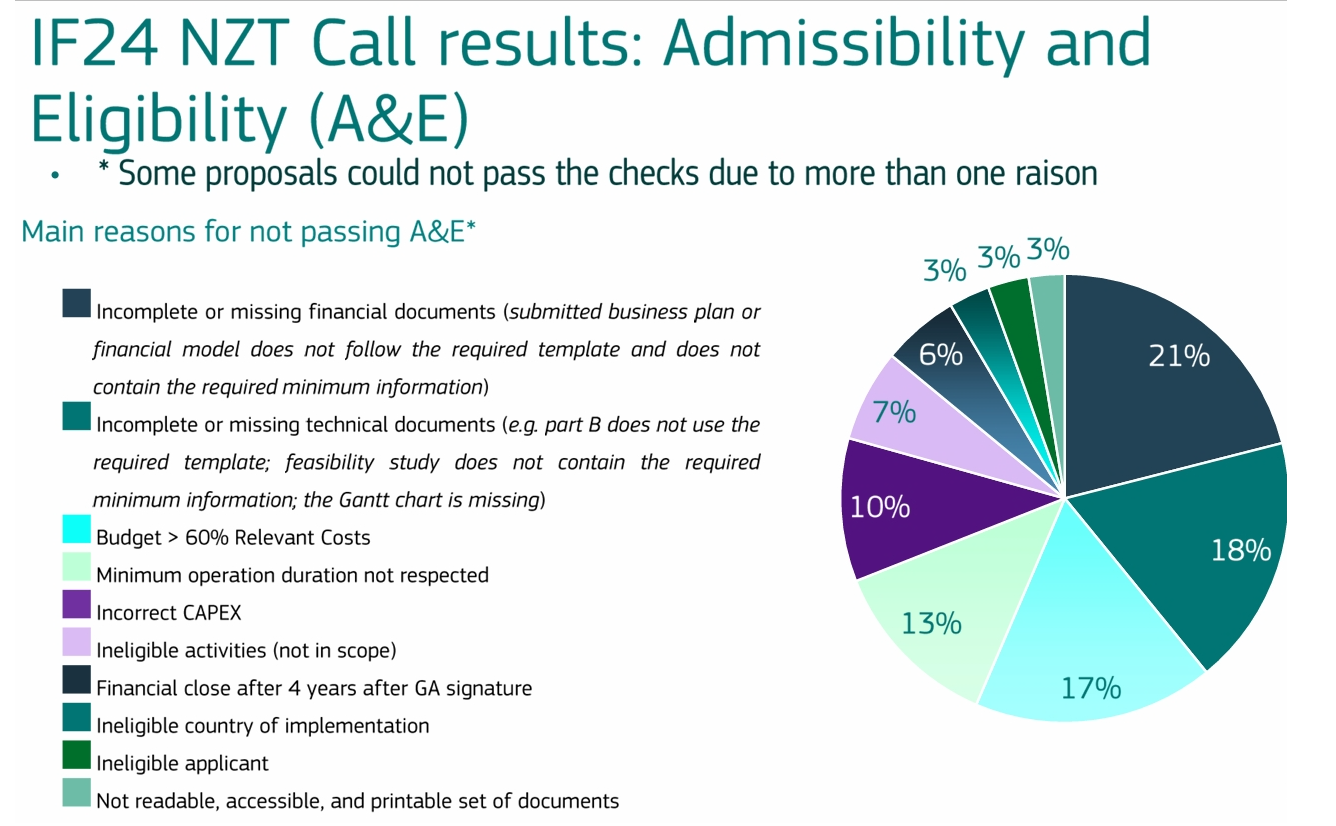
At the Admissibility & Eligibility Stage, 68 (19%) of the 359 submitted application failed to meet the eligibility criteria and therefore, were excluced from further evaluation. 

A closer look reveals that 54% of the 68 were screened out because of insufficiencies within the financial documents (e.g., incorrect CAPEX, excessive budget), which means 36 (10% of the 359) applications did not pass the A&E stage due to deficiencies within the financial and business plans.
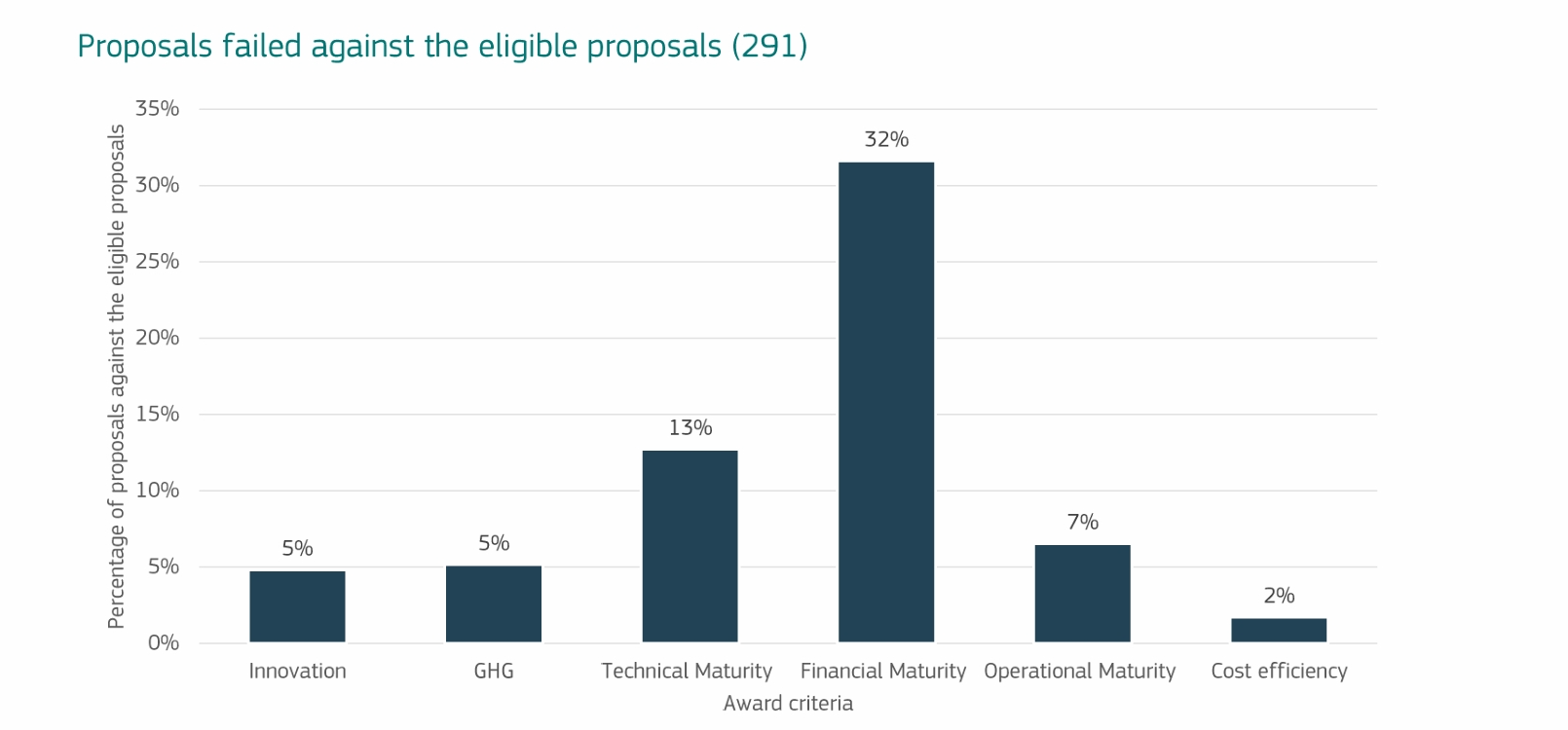
Of the 291 applications that passed the Application Evaluation Stage stage, 92 – or 32% of the evaluated applications - failed to meet the IF’s evaluation criteria for financial maturity.  As shown below, the lack of financial maturity was, by far, the most common reason for failed applications.

This means that, of the 359 submitted applications, 128 – or 36% - were excluded or failed due to insufficiencies within the financial section of their submissions.  While this indicates the most common challenge for FOAK projects, it also identifies the area of opportunity, where applicants can most significantly strengthen their application’s chance of success.  


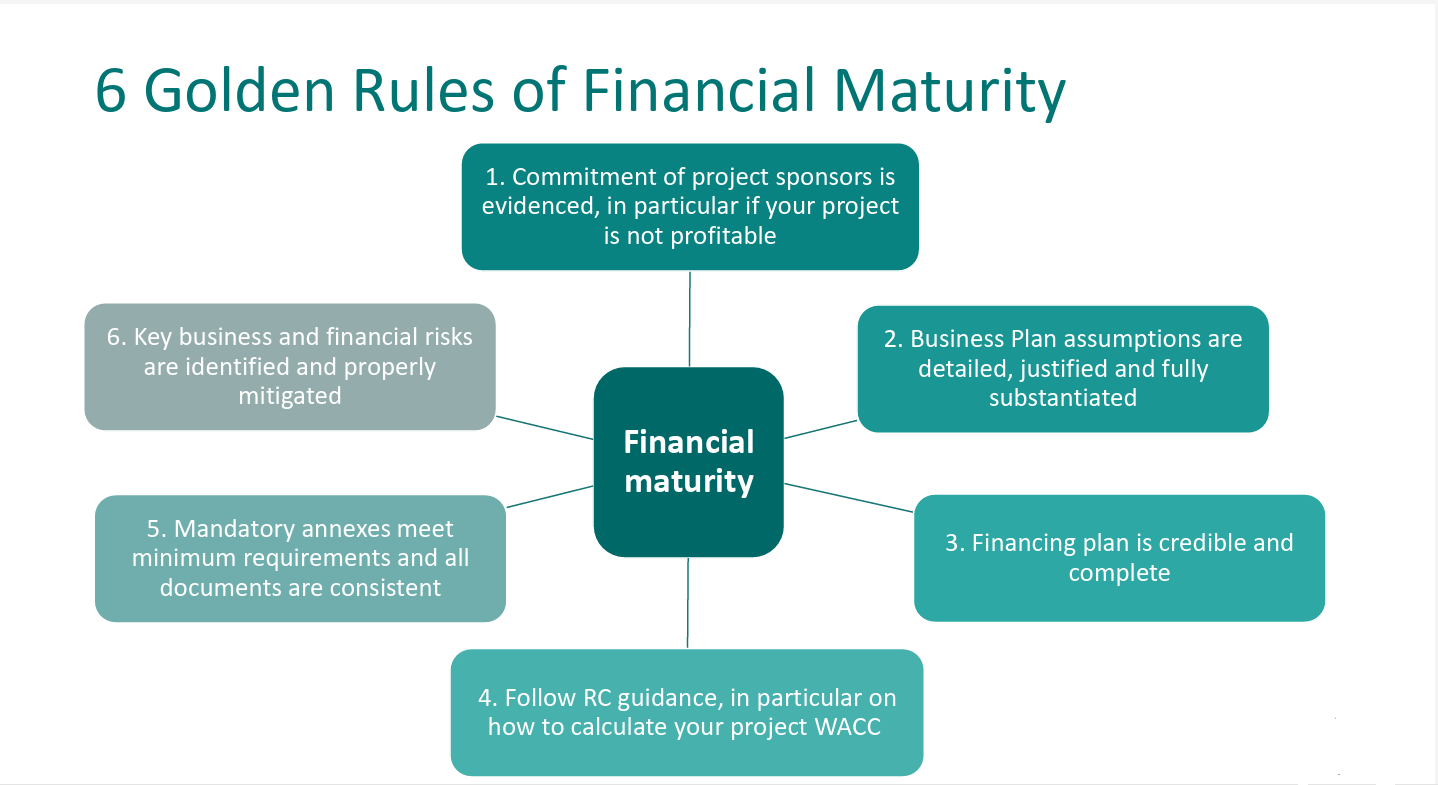
Demonstrating financial maturity goes far beyond providing Letters of Intent (LOIs) as evidence of project financing or simply identifying potential financial partners.

As illustrated in the 6 Golden Rules of Financial Maturity overview below, achieving financial maturity requires attention to both the bigger picture and the finer details. At a strategic level, this means developing solid, credible business and financing plans, identifying andaddressing risks, and securing commitments from key project sponsors and offtakers. At a more detailed level, it requires ensuring consistency across all application documents and applying the correct calculation methodologies within the financial model.


The importance of credibility is also reflected in CINEA's findings. According to CINEA, the most common weakness in insufficient Business Plans was a lack of credibility. Financing Plans faced similar challenges, often lacking a plausible financing strategy or relying on unrealistic debt assumptions.
 

Financial Maturity in Practice

Norwegian Hydrogen’s RjukanLH2 project aims to establish Europe’s first complete green liquid hydrogen (LH2) value chain dedicated to maritime freight transport, integrating hydrogen production, liquefaction and bunkering to support zero-emission shipping.

Working closely with Nordic Innovators and Nordic Innovators Corporate Finance (NICF), Norwegian Hydrogen successfully secured €31.5 million from the 2024 Innovation Fund, with a strong focus on demonstrating the project's financial maturity.

Demonstrating Financial Maturity

As a first-of-a-kind (FOAK) project introducing liquid hydrogen to a maritime market still in its infancy, RjukanLH2 faced several financing challenges:

• Securing offtakers: Identifying shipping partners willing to commit to liquid hydrogen purchases, a key prerequisite for project financing.
• Attracting lenders: Finding financial institutions willing to accept early-stage technology and market risks.
• Aligning stakeholder interests: Structuring offtake agreements that satisfied the project, offtakers and financiers.
• Building financial credibility: Developing robust business and financing plans supported by credible commitments and consistent financial assumptions.

Keys to Innovation Fund Application Success

We worked closely with Norwegian Hydrogen to develop a financially credible and competitive application. This included building a robust business plan with realistic revenue projections, supported by Letters of Support (LoS) from potential offtakers, and a convincing financing plan demonstrating access to debt financing through Letters of Intent (LoI). Key business and financial risks were also identified and addressed through credible mitigation strategies.

NICF strengthened the project's bankability by providing supporting financial evidence and demonstrating its feasibility. Crucially, the financial analysis compared the project's economics with and without Innovation Fund support, establishing the need for public funding in a market not yet sufficiently de-risked to attract private capital.

The close integration of Nordic Innovators' proposal and Corporate Finance teams ensured a consistent financial narrative throughout the application. As a result, RjukanLH2 achieved a high score for financial maturity, contributing to its successful Innovation Fund application.

Financial Maturity Goes Beyond Grant Writing

While the Innovation Fund does not expect FOAK projects to have reached Final Investment Decision (FID) at the application stage, it requires a credible, well-supported and de-risked plan to get there.

Financial maturity is therefore much more than an application requirement. It brings together the commercial, financial and strategic elements needed to demonstrate a project's viability to lenders and investors – making it a critical factor in both Innovation Fund success and the project's long-term realisation.

Successfully Demonstrating Financial Maturity in an IF Project

Successfully Demonstrating Financial Maturity in an IF Project

How does demonstrating financial maturity look like in practice, particularly for a first-of-a-kind project facing significant technological, commercial and financing risks?

Our client, Norwegian Hydrogen’s RjukanLH2 project provides a compelling example of how a strong financial strategy, credible business and financing plans, and close collaboration between funding and corporate finance experts can help overcome these challenges and contribute to a successful Innovation Fund application.

Nordic Innovators Copenhagen, Denmark

Teglværksgade 27 A, st. 
DK-2100 Copenhagen
Vat no.: 35526706

Phone: +45 31 76 64 35
E-mail: info@nordicinnovators.dk

Nordic Innovators Aarhus, Denmark

Skæringvej 88, building K1, 2nd floor

DK-8520 Lystrup

Vat no.: 35526706

Phone: +45 31 76 64 35
E-mail: info@nordicinnovators.dk

Nordic Innovators Málaga, Spain

Avenida de Andalucía 15, 1-3,
29002 Malaga
CIF.no.: B93349280

Phone: +34 951 245 480
E-mail: info@nordicinnovators.dk

Nordic Innovators Bergen, Norway

Damsgårdsveien 37
5058 Bergen
Org.no.: 921859872

Phone: +47 416 71 794
E-mail: info@nordicinnovators.dk

Nordic Innovators Drammen, Norway

Amtmand Bloms gate 1
3015 Drammen
Norway

Phone: +47 416 71 794
E-mail: info@nordicinnovators.dk

What We Do
  • Strategic Funding Advice
  • Corporate Finance
  • Sustainability Advisory
Funding Programmes
  • EU Funding Programmes
  • Danish Funding Programmes
  • Norwegian Funding Programmes
  • Spanish Funding Programmes
Case Overview
  • Read the case story of Piql
  • Read the case story of Tada Medical
  • Read the case story of Pentalock
  • Read the case story of PreDiagnose
Who We are
  • Join us
  • Get to know us better
  • Our Code of Conduct
  • Subscribe to our Newsletter
© 2026 Nordic Innovators. All Rights Reserved  | Manage cookie consent
linked-in.svg